
01What it is
Agentic applications are being built fast, and so are the attacks on them. More and more, the attacker is itself an AI: one model writes the injection that a second model is meant to obey, hides it in a page, a document or another agent's reply, and varies it until something gets through. Zscaler ThreatLabz put it plainly in its 2026 report: AI agents will phish other AI agents.
That is the problem K9-AIF exists to solve: an AI should not fall for another AI's attack. The framework answers it with layers that don't depend on the model behaving well: deterministic Shield checks, Granite Guardian as a semantic second opinion, signed identity and Zero Trust so an agent can't simply claim authority, screening of tool results so retrieved content is treated as untrusted, and a human in the loop for decisions that matter.
But attacks that are generated, not hand-written, change faster than any release cycle. A control written last quarter can be paraphrased around this week. Sentinel is the part of the K9X ecosystem that keeps up: every new technique is checked against what the framework does today, so its defences are maintained, not frozen at their last release.
Router → Orchestrators → Squads → Agents, governed by k9x Shield and Granite Guardian, with human review through the framework's own HIL path. It uses what it protects.
Sentinel finds and explains. A person decides. Sentinel never changes code; an approval becomes a draft advisory or an issue for the maintainers.
A gap is an unpatched weakness in a public framework. Findings stay behind a login, cases carry only a reference, and gaps go to draft advisories.
02What it does
Every morning at 06:00:
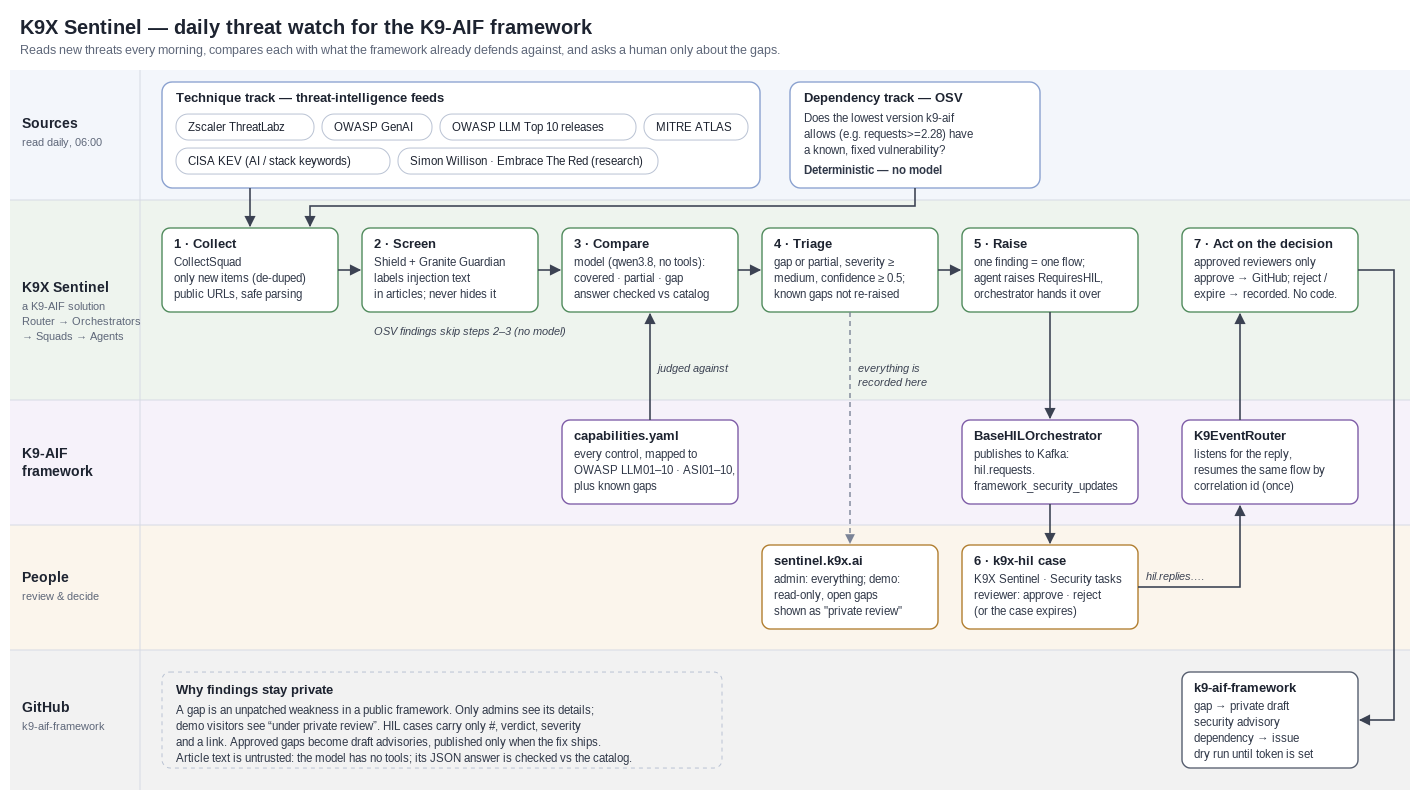
| Track | Reads | Decides |
|---|---|---|
| Techniques | Zscaler ThreatLabz, OWASP GenAI, OWASP LLM Top 10 and MITRE ATLAS releases, CISA KEV (AI and stack keywords), agent-security researchers (Simon Willison, Embrace The Red) | A local model compares the article with the framework's capability catalog: covered, partial, gap or not relevant, with OWASP ids, the controls that apply, severity, confidence, rationale and a suggested fix. |
| Dependencies | OSV, for every package k9-aif declares | No model. Is the lowest version k9-aif allows affected by an advisory that has a fix? Then "raise the floor to X". |
Only relevant gaps and partial gaps of at least medium severity reach a person. Everything else is recorded and visible in Sentinel.
The sources it reads today
Configured in config.yaml (sentinel.sources): adding a feed is one entry.
| Source | Kind | Endpoint |
|---|---|---|
| loading… | ||
03How it keeps K9-AIF current
The key is the capability catalog, k9_security/capabilities.yaml, which ships inside k9-aif. It lists every control (25 today) mapped to OWASP Top 10 for LLM Applications 2025 and OWASP Top 10 for Agentic Applications 2026, with its limits, plus the gaps the maintainers already know about. The catalog closes the loop:
- A new technique is published. Sentinel judges it against the catalog of the k9-aif version you run, and finds a gap or partial gap.
- A reviewer approves it in k9x-hil. Sentinel opens a private draft security advisory, or an issue for a dependency floor.
- The maintainers close it: a new Shield check, a new Guardian risk, a safer default, a raised dependency floor.
- The same commit updates
capabilities.yaml. A framework test fails if a control is added without being listed, so the catalog can't drift from the code. - From the next release on, Sentinel judges the same kind of threat against the new catalog, and it comes back covered. A threat the maintainers already track is linked to its known gap rather than raised again.
The result is a framework whose answer to "are you protected against X?" is written down, mapped to a public standard, checked against the code by a test, and challenged every day by the outside world.
04What an architect should do for an organization
Sentinel is a tool. The practice around it is the architect's. In TOGAF terms, this is Phase H, Architecture Change Management, driven by the threat landscape: Sentinel is the change trigger, the Architecture Board is the reviewer, and the catalog is the governed record of what the architecture defends against.
1. Know the difference between "the framework can" and "we do"
Most K9-AIF controls are opt-in: the catalog marks each one enabled_by_default. A threat Sentinel calls covered is covered by a control the framework offers. For each of your solutions, keep a short profile of which controls are actually switched on: which Shield checks are on the ingress and egress lists, whether Guardian runs, whether signed identity and Zero Trust are enabled. Review it whenever Sentinel reports a "covered" threat that matters to you. A covered threat in a solution that left the control off is still an open door.
2. Decide who reviews, and how fast
Name the approvers (SENTINEL_HIL_APPROVERS), usually the security architect plus one framework maintainer. Cases expire after 14 days unless decided. Treat an expiry as a governance failure, not a "no".
3. Set the triage policy to your risk appetite
config.yaml → sentinel.triage: minimum severity, minimum confidence, and whether instances of known gaps are raised again. Regulated or federal programmes should usually lower the severity floor to low and accept more review work.
4. Add your own sources
Any RSS or Atom feed is one entry in config.yaml: your SOC's advisories, your cloud and model vendors' security bulletins, your sector ISAC. Sentinel treats every one as untrusted input.
5. Audit the "covered" and "not relevant" calls
The model can be wrong in the comfortable direction. Once a month, read a sample of items Sentinel did not raise. If you find a miss, tighten the triage policy or add the missing limit to the catalog.
6. Keep the findings private, and the disclosure path deliberate
Run Sentinel on the LAN only. Approved gaps go to draft security advisories, and are published only when the fix ships, ideally with a CVE. Internal solutions built on K9-AIF should learn about a fix through your change process before the advisory is public.
05Set it up
Prerequisites
- Ollama with an analysis model (default
qwen3.8:27b) and Granite Guardian (granite4.1-guardian:8b, mandatory; Sentinel refuses to run without it). - Kafka or Redpanda plus k9x-hil, for human review. k9x-hil creates the Framework Security Updates queue at start-up. Without Kafka, findings stay in Sentinel's own UI.
- Optional: a fine-grained GitHub token for the framework repository (repository security advisories: write, issues: write). Without it, approvals are recorded as dry runs showing the exact request.
Install
git clone https://github.com/k9aif/k9x-sentinel.git && cd k9x-sentinel
cp .env.example .env        # Ollama host, Kafka broker, SENTINEL_PASSWORD, approvers
python3.11 -m venv .venv && .venv/bin/pip install -r requirements-dev.txt
./run.sh                    # pre-flight, then http://localhost:8114
Run it as a container
ubuntu/build-run.sh all     # build + start on port 8114 (LAN only)
ubuntu/build-run.sh logs    # pre-flight results
ubuntu/build-run.sh run     # run now instead of waiting for 06:00
First week
- Do the first run with
KAFKA_BROKERempty. Read every finding in the UI and calibrate the triage policy before anything reaches reviewers. - Turn on HIL, name the approvers, and keep
SENTINEL_GITHUB_MODE=dry_rununtil the approvals look right. - Then add the GitHub token and switch to
live.
06Limits, stated plainly
- It judges the framework's capabilities, not your deployment's configuration (see section 04.1).
- Verdicts come from a model. They are evidence for a reviewer, not a decision. Every raised finding is reviewed by a person.
- It reads public feeds in English. Content behind registration walls, such as full vendor reports, still has to be read by a person.
- Human review is only as strong as the review system. k9x-hil must take the decision's author from the login and restrict tasks to their application before Sentinel's approver list can be fully trusted.